August 6, 2026
Why Third Places Matter More Than Ever
Written by: Tino Noir
Ray Oldenburg called them third places in 1989. We've been dismantling them ever since — and the isolation it caused is finally impossible to ignore.
Ray Oldenburg coined the term 'third place' in 1989, in a book called The Great Good Place that was largely ignored for a decade before it became required reading for city planners, sociologists, and architects trying to explain why neighborhoods were starting to feel hollow.
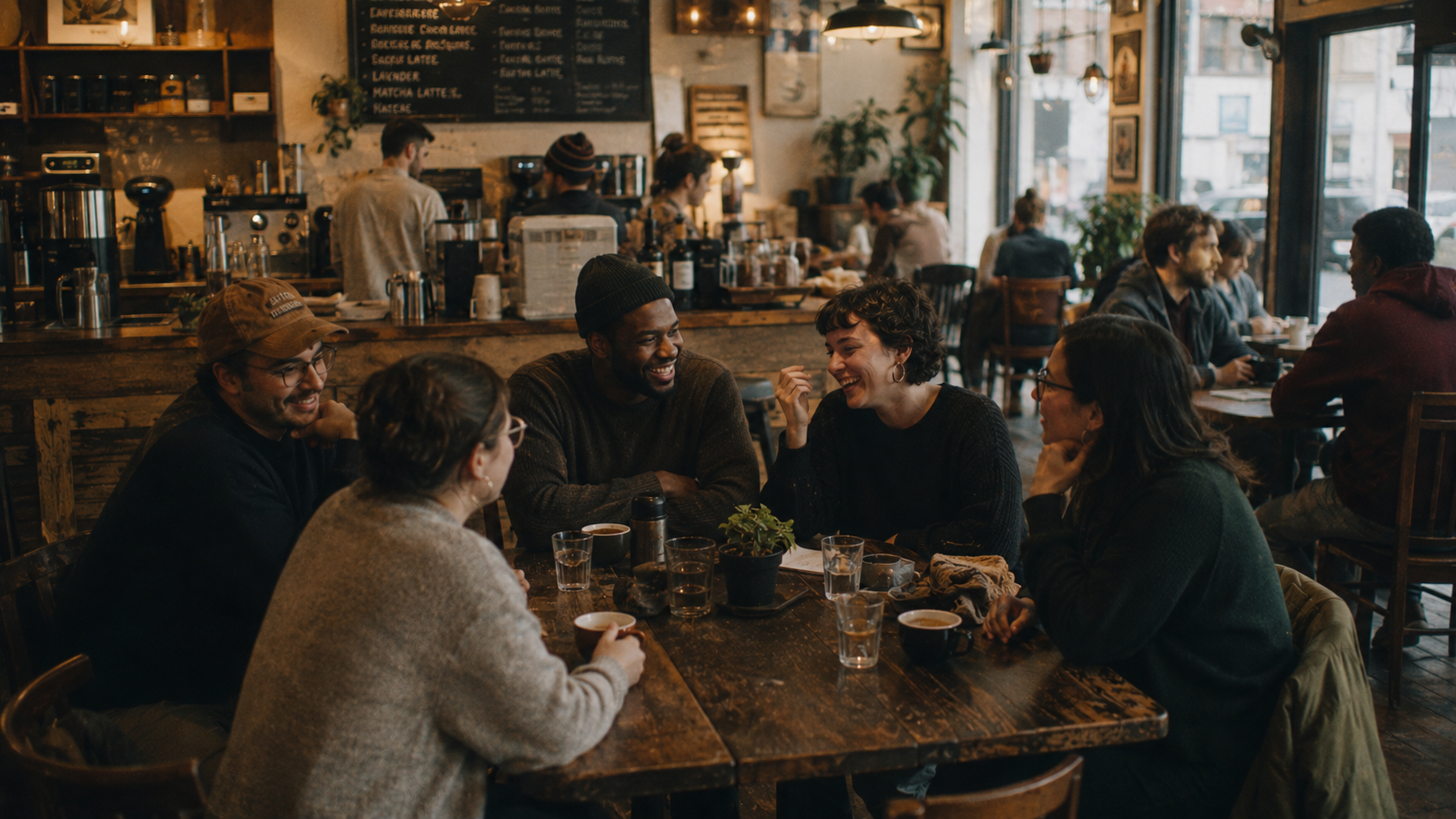
Home is the first place. Work is the second. The third place is everything else — the bar, the barbershop, the café, the diner where the same people show up at the same hour. The place where you're not a role or a function. Just a regular.
His argument was simple and, it turned out, prescient: these places are not amenities. They're infrastructure. And we've spent thirty-five years dismantling them.
What Oldenburg saw coming
When Oldenburg wrote, the shift was already underway. Suburbanization had replaced walkable neighborhoods with cul-de-sacs. Chain restaurants were replacing diners. Television was becoming the default evening activity, pulling people out of the pub and the front porch and the barbershop and back into their houses, where they were alone together behind separate screens.
He was documenting a disappearance in real time. The informal gathering places that had always anchored community life — the corner bar, the barber, the café where everyone knew the owner — were being replaced by spaces optimized for throughput and profit rather than lingering and belonging.
What he didn't know was how much faster it would go.
What replaced them
The delivery app is the most efficient third-place killer ever invented. You never have to go to the restaurant. You never sit at the counter, you never learn the owner's name, you never become a face that someone is quietly glad to see walk in. The food just appears at your door and the transaction is complete and invisible and no one is better off for the exchange except in the most transactional sense.
Remote work finished what the commute had started. The office was never a great third place — but the coffee shop on the way there was. The bar after was. Those trips, forced by the rhythm of the old working day, produced accidental regularity: you ended up at the same counter at the same time, week after week, without intending to build anything. When the commute disappeared, so did the occasion.
And social media completed the substitution. You can feel like you've been social — you've seen what people posted, responded, been seen responding — without having been anywhere. Without sitting in the same room as another human being who could read your face. The simulation of connection without the substance of it.
Why dense cities don't solve it
The loneliness epidemic is weirdest in cities. People who live in the densest neighborhoods in the world — surrounded by bars, cafés, parks, neighbors on every floor — report feeling profoundly isolated. This confuses people. The infrastructure is there. Why doesn't it work?
Because proximity isn't community. Passing the same faces in the lobby doesn't make you known to them. Walking past the same coffee shop doesn't make you a regular there. The physical density of a city gives you the raw material — but you have to do something with it. You have to go back. Show up twice. Give someone something to remember you by.
The city doesn't build that for you. Nothing does. It has to be built deliberately, visit by visit, the way it always was — just without the accidents that used to help.
The third place isn't gone
Here's the thing: the places are still there. Not all of them, and not as many as there used to be — the economics are brutal and the good ones close faster than the bad ones. But there are bars and coffee shops and barbershops and gyms and studios where the same people show up on the same days and the staff learn their names over time. The third place exists. It just doesn't find you anymore.
What's changed is not the supply. It's the intentionality required to use it.
Finding a third place used to happen by accident — you lived near something and it became yours by default, by repetition, by the ordinary friction of going somewhere because it was close and open. Now it requires a decision. Pick a place. Go back. Show up on a night when you'd rather stay in. Talk to the person making your drink instead of looking at your phone while they do it. Learn a name. Leave a thread.
Go build one
The antidote to isolation in a city full of people is not another app, not a curated event, not a group chat that never quite translates into a room. It's a place where you're known — specifically, personally, across time.
The belonging that third places produce is not complicated. It's the accumulated result of going back: to the same stool, the same order, the same faces. A bar that knows your drink. A barbershop where they remember how you had it cut last time. A gym where someone notices when you've been gone a week.
That's available to you right now. Probably closer than you think. You just have to show up twice — and then once more after that.
TAOBAR is built for this — for the places you keep going back to, and the people who make them worth going back to. Save your spots. Remember the faces. Walk in ready to be known. The third place you've been looking for is probably somewhere you've already been.
TAOBAR
Walk in ready.
TAOBAR is live on iOS. Download the beta and walk in ready.